
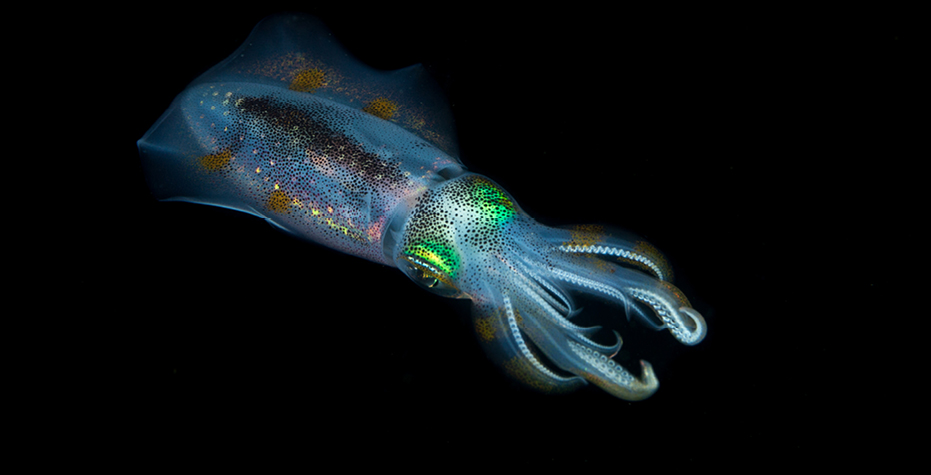
Night diving in South Sound reveals a different cast of characters. By moonlight and torchbeam, crabs scuttle, lobsters march, and octopi dance across the reef. Sleek tarpons, stealthy moray eels, and the ever-hungry barracuda become the main event. Even the coral transforms. It blooms and feeds under the cover of darkness.
But for the truly adventurous, that’s just the beginning.
Black water diving: Earth’s deepest migration comes to the surface
Few ever witness the underwater migrations of the sea. Each night a vertical movement of deep-sea creatures rise from the ocean’s depths to feed under cover of night. With Don Foster’s black water dive, when all the lights are turned off, you can witness nature’s glowing gifts of alien-like organisms that spark like underwater stars.
This isn’t your typical reef-based scuba experience. Divers join a shallow dive around 40 to 60 feet while suspended in the dark over deep, open water. A glowing downline is the only reference as divers drift over the abyss. There’s nothing but black, dark waters beneath and luminous life passing by.
A specially rigged buoy system deploys a red-lit rope that drops to 60 feet with lights staged at various depths to attract the deep-sea travelers. Divers remain untethered, floating freely near the downline as the boat follows above.
The creatures you might see
Each dive offers a glimpse into the strange and spectacular world that is hardly seen or known. You may spot larval lionfish, flounders, triggerfish, or tripod fish. Or, you may just encounter one of the oddities listed below that are rarely seen by divers.
Paper nautilus
The paper nautilus is a pelagic octopus that creates a delicate egg case, often mistaken for a true shell. These fascinating creatures are rarely seen, even though their egg cases occasionally wash up on shore and are collected by beachcombers. Males are tiny and mate by detaching a sperm-filled arm, which enters the female’s gills and remains there until she is ready to fertilize her eggs.
Paralarva octopus
Paralarvae are miniature, transparent versions of adult octopuses that drift freely in the open ocean. Unlike most mollusks, they hatch already resembling adults and skip a complex metamorphosis stage. Their tiny size and planktonic lifestyle make them almost invisible to the human eye, except during black water dives.
Diamond squid
This squid is named for its long, diamond-shaped fins that allow it to glide smoothly through the water. Its movement is graceful and fluid, unlike the jet-propelled bursts seen in many other squid species. Though not critically endangered, diamond squid are rarely observed by divers due to their deep-water habitat.
Sharp ear enope squid
The sharp ear enope squid emits a brilliant blue glow, earning it the nickname “firefly of the sea.” It has a streamlined, transparent body and long arms lined with hooks. Seeing this bioluminescent species is a rare sight as it is commonly found thousands of metres below the surface.
Snaketooth swallower
This deep-sea fish has massive jaws and a stretchable stomach that allow it to swallow prey larger than its own body. It lives at extreme depths, often well beyond the reach of recreational divers. Most sightings come from submersibles or deep-sea trawling operations.
Whale fish
Whale fish are deep-dwelling creatures found at 1,000 meters (3,300 feet) that undergo dramatic changes throughout their life cycle. As males mature, they lose their jaws and stomach and survive on stored energy. They are almost never seen by divers and are known primarily through deep-sea scientific research.
Sea butterfly
Also known as “flying snails,” sea butterflies use wing-like feet to flutter through the water in slow, graceful movements. They begin life as males and become females as they grow larger. These delicate, translucent creatures trap plankton in mucus webs and are best seen during night or black water dives.
Is this dive for you?
If you are an experienced night diver, especially a photographer looking for something truly rare, this is your next frontier. Here’s what you need:
- Previous night diving experience
- Excellent buoyancy control
- A long-sleeved rash guard and leggings to protect against jellyfish or stingers
- A powerful dive light, essential to light up creatures that shimmer when illuminated
- Comfort in open ocean conditions at night
Typical bottom time is up to 90 minutes. Divers may end their dive at any point during that window.
Why it matters
Black water diving doesn’t just offer breathtaking visuals. It’s a reminder of how much of our world remains hidden. To drift among these fragile, alien-like creatures is to witness a nightly ritual that has happened for millennia, unseen by most humans.
If you’re ready to leave the reef behind and plunge into a spectacle that few divers ever experience, this is it.